State electricity profile · EIA monthly through May 2026
Iowa Electricity
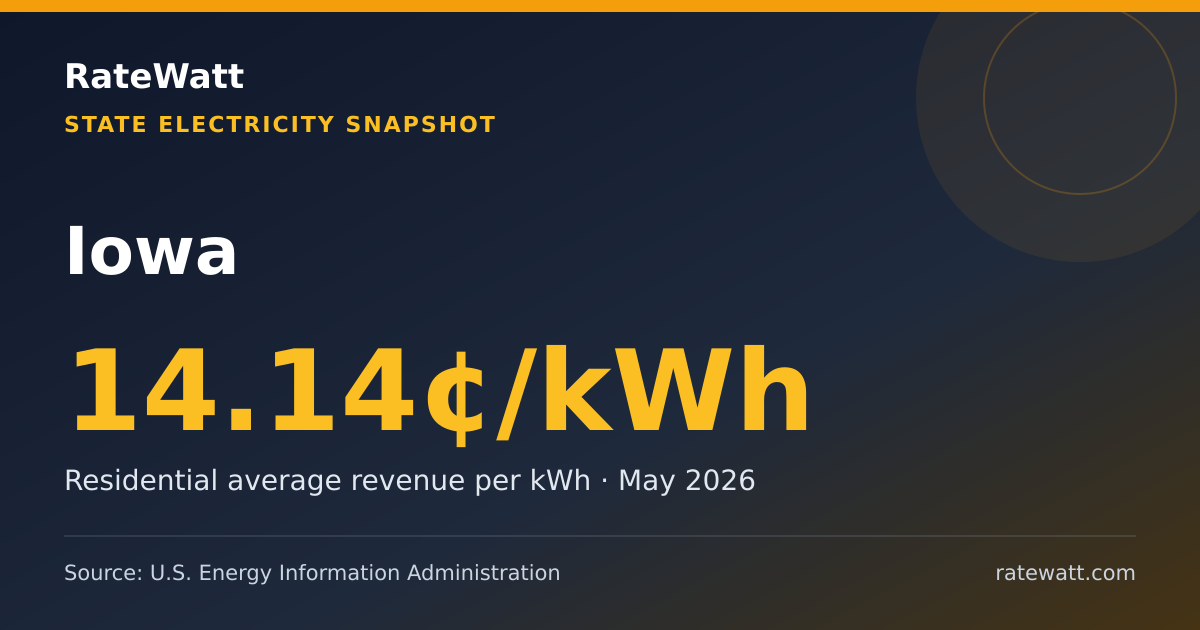
As of May 2026, residential electricity in Iowa costs 14.14¢ per kWh (-0.1% vs May 2025). EIA publishes these figures monthly and this page follows them. Iowa's 2025 annual residential electricity rate is 13.72¢/kWh, 20.7% below the US average. That is a below-average rate alongside 63% renewable generation, the combination the national debate usually treats as a trade-off. The sector and fuel detail below shows how it is built.
- 14.14¢
- May 2026 rate
- -0.1%
- year over year
- 13.72¢/kWh
- Residential rate
- -20.7%
- vs US average
- 63%
- Renewable
- 1.5M
- Customers
Verify with EIA → · Methodology
13.72¢/kWh residential, 11.05¢/kWh commercial
In the U.S. Energy Information Administration's 2025 annual-frequency retail-sales series, Iowa's residential average revenue per kWh is 13.72¢/kWh, with a commercial average of 11.05¢/kWh and an industrial average of 7.20¢/kWh; a separate EIA generation series for 2025 reports 63% of the state's generation from renewables.
- 20.7% below the US average vs national residential average
- 63% renewable generation
The verdict · 2025
Iowa's residential electricity runs 13.72¢/kWh - 20.7% below the 17.30¢/kWh national average, cheaper than 70% of other states, with 63% of its power from renewables.
This is EIA state average revenue per kWh across 1.5M reported residential customers, a benchmark for comparing states, not the tariff on any single bill. Source: EIA retail-sales API, annual frequency.
Annual rate change
What changed in the 2025 annual EIA period
- Iowa's commercial average rose from 10.22¢/kWh to 11.05¢/kWh between the 2024 and 2025 annual-frequency EIA retail-sales periods, a change of +8.1%.
- Iowa's industrial average rose from 6.80¢/kWh to 7.20¢/kWh between the 2024 and 2025 annual-frequency EIA retail-sales periods, a change of +5.9%.
- Iowa's residential average rose from 13.40¢/kWh to 13.72¢/kWh between the 2024 and 2025 annual-frequency EIA retail-sales periods, a change of +2.4%.
Energy Generation Mix (2025)
How Iowa generates its electricity, from the EIA generation series for 2025 (separate from the 2025 retail-sales price figures above). Renewable sources account for 62.7% of generation.
- Windrenewable58.6%
- Coal25.6%
- Natural Gas11.6%
- Solarrenewable2.5%
- Hydrorenewable1.5%
- Biomassrenewable0.1%
- Petroleum0.1%
Who generates Iowa's electricity
Iowa has 534 operable generating units on EIA's inventory totalling 23,434 MW of net summer capacity. The largest single plant is Walter Scott Jr Energy Center , a conventional steam coal station operated by MidAmerican Energy Co , rated 1,512 MW.
Balancing authorities keep supply and demand matched on the grid; the largest here by capacity are Midcontinent Independent Transmission System Operator, Inc., Southwest Power Pool and Associated Electric Cooperative, Inc.
Showing the 16 largest of 264 operable plants in Iowa by net summer capacity.
| Plant | Operator | Technology | County | MW |
|---|---|---|---|---|
| Walter Scott Jr Energy Center | MidAmerican Energy Co | Conventional Steam Coal | – | 1,512 |
| Louisa | MidAmerican Energy Co | Conventional Steam Coal | – | 746 |
| Ottumwa | Interstate Power and Light Co | Conventional Steam Coal | – | 714 |
| Marshalltown Generating Station | Interstate Power and Light Co | Natural Gas Fired Combined Cycle | – | 668 |
| George Neal South | MidAmerican Energy Co | Conventional Steam Coal | – | 647 |
| Emery Station | Interstate Power and Light Co | Natural Gas Fired Combined Cycle | – | 539 |
| George Neal North | MidAmerican Energy Co | Conventional Steam Coal | – | 510 |
| Greater Des Moines | MidAmerican Energy Co | Natural Gas Fired Combined Cycle | – | 504 |
| Highland Wind Project (IA) | MidAmerican Energy Co | Onshore Wind Turbine | – | 500 |
| Orient Wind Farm | MidAmerican Energy Co | Onshore Wind Turbine | – | 500 |
| Rolling Hills Wind Farm | MidAmerican Energy Co | Onshore Wind Turbine | – | 443 |
| Beaver Creek Wind | MidAmerican Energy Co | Onshore Wind Turbine | – | 340 |
| North English | MidAmerican Energy Co | Onshore Wind Turbine | – | 340 |
| Palo Alto Wind Farm | MidAmerican Energy Co | Onshore Wind Turbine | – | 340 |
| Arbor Hill Wind Farm | MidAmerican Energy Co | Onshore Wind Turbine | – | 310 |
| Ida Grove Wind | MidAmerican Energy Co | Onshore Wind Turbine | – | 300 |
| Operating company | Plants | Net summer MW |
|---|---|---|
| MidAmerican Energy Co | 56 | 12,445 |
| Interstate Power and Light Co | 29 | 4,329 |
| Archer Daniels Midland Co | 3 | 483 |
| Avangrid Power LLC | 5 | 402 |
| Pioneer Prairie Wind Farm I, LLC | 1 | 300 |
| Board of Water Electric & Communications | 1 | 249 |
| Great Pathfinder Wind | 1 | 224 |
| Duke Energy Renewables Services | 1 | 200 |
| EDF Renewable Asset Holdings, Inc. | 1 | 200 |
| Heartland Divide II | 1 | 200 |
Operable units only, from EIA's generator inventory as reported for 2026-05. Capacity is net summer rating, which is what a unit can reliably deliver in peak conditions rather than its nameplate figure. Ownership and operatorship can differ; the company shown is the one EIA records as operating the unit.
What Iowa's Electricity Data Tells Us
Residential customers in Iowa pay 13.72¢/kWh in 2025, across 1.5M metered households, placing the state 20.7% below the national residential average of 17.30¢/kWh. Commercial rates sit at 11.05¢/kWh while industrial buyers pay 7.20¢/kWh. These sector averages describe recorded revenue per kWh; this dataset alone does not establish why they differ. Annual residential sales total 15.1M MWh on roughly $2.1B in utility revenue. Sales and revenue are reported retail-series measures and should not be treated as a local load forecast.
Iowa's industrial rate ranks 41 of 51 while its residential rate ranks 36, so the gap between what a factory and a household pay is narrower here than in most states. Wind carries the majority of Iowa's in-state generation at 58.6%, though not the whole grid: coal supplies 25.6% and natural gas a further 11.6%. It is the leading fuel in 5 states. Renewable fuels (solar, wind, hydro, geothermal and biomass) account for 62.7% of Iowa's electricity output. These shares describe in-state generation, not a utility-specific customer bill.
Looking back across EIA records, residential prices in Iowa moved from 11.94¢/kWh in 2016 to 13.72¢/kWh in 2025, a 14.9% shift over that window. States charging a similar rate include Missouri, North Carolina, Mississippi, a useful peer set for a sanity check. Wind has no fuel bill, so Iowa's costs sit in transmission and in what fills the hours when the wind is down. That inverts the usual reading: the rate above is less about commodity prices than about how much back-up capacity the state keeps standing. Read the number as a floor rather than a promise. A statewide average this far under the national figure is usually held down by a few large low-cost generators, and a household on the wrong side of a service-territory boundary in Iowa can pay well above it.
-20.7%
Much cheaper vs the US residential average
70%
of states have higher rates — Below-average cost
63%
Significant renewable — above the 25% US mix
1.5M
residential customers served
Residential Price History
Iowa residential average revenue per kWh moved from 11.94¢/kWh in 2016 to 13.72¢/kWh in 2025 (14.9% over the window).
- Iowa residential avg
- 13.72¢/kWh 14.9% since 2016
- 2016 → 2025
- Iowa residential: 2016, 11.9¢
- Iowa residential: 2017, 12.3¢
- Iowa residential: 2018, 12.2¢
- Iowa residential: 2019, 12.5¢
- Iowa residential: 2020, 12.5¢
- Iowa residential: 2021, 12.7¢
- Iowa residential: 2022, 13.2¢
- Iowa residential: 2023, 13.3¢
- Iowa residential: 2024, 13.4¢
- Iowa residential: 2025, 13.7¢
Source: U.S. Energy Information Administration, retail-sales API · annual frequency. Iowa full trend →
Iowa Average Price by Sector and Year (¢/kWh)
The chart above tracks households only. In 2025, Iowa households paid 13.72¢/kWh while businesses paid 11.05¢/kWh, a 24.2% residential premium, a moderate household-versus-business gap. Every year EIA has published is below, so a single year can be read across all three sectors rather than assembled from three separate EIA queries.
| Year | Residential | Commercial | Industrial |
|---|---|---|---|
| 2025 | 13.72¢/kWh | 11.05¢/kWh | 7.20¢/kWh |
| 2024 | 13.40¢/kWh | 10.22¢/kWh | 6.80¢/kWh |
| 2023 | 13.31¢/kWh | 10.33¢/kWh | 6.91¢/kWh |
| 2022 | 13.15¢/kWh | 10.55¢/kWh | 7.06¢/kWh |
| 2021 | 12.73¢/kWh | 10.17¢/kWh | 6.63¢/kWh |
| 2020 | 12.46¢/kWh | 9.96¢/kWh | 6.43¢/kWh |
| 2019 | 12.46¢/kWh | 9.99¢/kWh | 6.60¢/kWh |
| 2018 | 12.24¢/kWh | 9.68¢/kWh | 6.45¢/kWh |
| 2017 | 12.34¢/kWh | 9.46¢/kWh | 6.21¢/kWh |
| 2016 | 11.94¢/kWh | 9.17¢/kWh | 6.05¢/kWh |
Average revenue per kilowatt-hour, U.S. Energy Information Administration annual-frequency retail-sales series. Revenue per kWh is what customers in each sector actually paid on average, not an advertised tariff rate. Years with no EIA figure for a sector show —.
Where Iowa's residential rate sits nationally
2025 average revenue per kWh across every reporting state
13.72¢/kWh Top 32% most affordable More affordable than 70% of 50 other states
all reporting states, equal-width bands
Each bar spans 5¢/kWh. Taller bars contain more states; the dashed marker locates this state. Hover, focus or tap a bar for its exact count and share.
Source U.S. Energy Information Administration, retail-sales API · 2025 annual frequency
How Iowa compares
Average revenue per kWh, EIA retail-sales API. Pick a benchmark above to compare Iowa against the US average or a peer state.
Market Overview
Residential Revenue
$2.1B
Commercial Revenue
$1.5B
Residential Sales
15.1M MWh
Residential Customers
1.5M
Using Iowa's numbers
A grid this renewable is close to the end of the supply-build phase, so Iowa's rate is increasingly set by what it costs to keep power available in the hours renewables do not cover, not by adding more of them.
- Iowa sits 20.7% below the national average, see exactly where it lands among all 50 states. See the rankings
- Check the multi-year trend before you judge the rate, a low price rising fast can cost more over a decade than a steady one. Iowa price trend
- Compare Iowa side by side with the US average and peer states using the tool above, then estimate your own bill from your monthly kWh. Cost calculator
Figures are EIA state averages by sector, computed as revenue divided by sales, so delivery and taxes are inside them but not broken out. Your actual rate depends on your utility, plan, and usage, see our disclaimer.
States with Similar Electricity Prices
Other states led by wind
These grids also report wind as their largest generation share in the latest EIA mix — a different peer set from the price neighbors above.
Frequently Asked Questions
How much does electricity cost in Iowa? ▼
Where does Iowa's residential electricity rate rank nationally? ▼
How much of Iowa's electricity is renewable? ▼
Are electricity prices going up in Iowa? ▼
What are commercial and industrial electricity rates in Iowa? ▼
Which energy sources generate the most electricity in Iowa? ▼
Where does RateWatt's Iowa electricity data come from? ▼
Read with Iowa: cheapest states for electricity
Where Iowa's figures come from
Every price and generation figure on this page is drawn from the EIA series below, and from nothing else.
Utilities serving Iowa
The 24 utilities that reported bundled residential service in Iowa to EIA Form 861 (2024), largest first. Entity prices below are Form 861 averages for that release, not the same survey as the 2025 retail-sales statewide average above, and not a household tariff. What an individual household pays depends on which of these serves its address.
| Utility | Ownership | Customers | Avg ¢/kWh |
|---|---|---|---|
| MidAmerican Energy Co | Investor Owned | 632.4K | 11.01¢ |
| Interstate Power and Light Co | Investor Owned | 417.2K | 17.90¢ |
| Linn County REC | Cooperative | 30.3K | 14.23¢ |
| City of Ames - (IA) | Municipal | 25.0K | 12.10¢ |
| Eastern Iowa Light & Power Coop | Cooperative | 20.7K | 13.56¢ |
| Cedar Falls Utilities | Municipal | 17.8K | 10.42¢ |
| Midland Power Coop | Cooperative | 11.9K | 13.60¢ |
| Maquoketa Valley Rrl Elec Coop | Cooperative | 11.1K | 13.76¢ |
| Board of Water Electric & Communications | Municipal | 10.1K | 12.63¢ |
| Iowa Lakes Electric Coop | Cooperative | 9.7K | 13.78¢ |
| North West Rural Electric Coop | Cooperative | 9.4K | 9.26¢ |
| Access Energy Coop | Cooperative | 8.8K | 14.95¢ |
| East-Central Iowa Rural Elec Coop | Cooperative | 7.4K | 13.28¢ |
| Consumers Energy Coop - (IA) | Cooperative | 6.9K | 15.00¢ |
| MiEnergy Cooperative | Cooperative | 6.0K | 16.91¢ |
Showing the 15 largest of 24 reporting utilities. The 2 serving 100.0K+ residential customers link to a full profile. Presence in EIA Form 861 is not evidence that a utility is available at a given address or that a customer may choose it.
Related
Disclaimer: This information is provided for informational purposes only and does not constitute professional advice. Data is sourced from the U.S. Energy Information Administration (EIA). Consult a qualified professional before making decisions based on this data.
Every figure on RateWatt is rendered directly from official U.S. Energy Information Administration (EIA) data, no number is typed in by an editor. Statewide prices use the EIA retail-sales annual series (2025). Generation mix uses a separate EIA generation series (2025). Utility rows use Form EIA-861 (2024) and are not averaged into the statewide retail-sales figure. See our editorial standards & corrections policy, the methodology behind these numbers, or report a data error. Data current as of 2025.